Showing posts with label What they don't teach you in law school.... Show all posts

Thursday, March 31, 2011

The Settlement Meeting Quiz

Cases can frequently be resolved by a simple phone call: “Hey, I got you a lot of money, let me settle your case”. The client hears this, is overjoyed and then promptly begins to complain when you give them their share of the settlement proceeds. However, not all clients and cases are this easy. There are those that require a face-to-face meeting. In the client’s home. With spreadsheets, pie-charts and a lot of caffeine.

Yesterday was my turn to take part in one of these meetings.

As I want you to learn (or at least laugh) from my experiences, I have a few questions for you that will allow you to focus on what really matters at these meetings. I’ve prepared a few questions for you based on my meeting yesterday.

Question 1: Upon entering a clients home for the first time you see is a large portrait of the client’s significant other portrayed as a celestial being (angelic looking...I think). You are ushered into the room for your meeting where said portrait is clearly the object that this room focuses on. Your client notices that you are ‘admiring’ this portrait and begins to talk about it. How do you respond?

  1. Compliment the artistic vision of the painter, but focus your most lavish praise upon the subject of this piece of “artwork”. Spend a lot of time talking about the way the light highlights her stunning facial features while stopping short of discussing the multiple chins.
  2. Stare at your feet, shuffle awkwardly and hide behind your partner until they stop looking at you.
  3. Compliment the client, the house, the hospitality and everything else that allows you to not talk about the damn painting which offends God’s sensibilities.
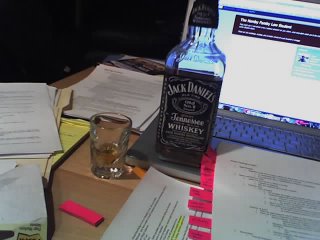
Question 2: You have just driven three and a half hours and your client is offering you hard liquor. You still have the return trip to accomplish (not to mention an early morning courtroom date with a Chicago judge the next day) and it is still quite early in the day. What do you say?
  1. “I’ll have what you are having. No wait...make that a double.”
  2. “I’m sorry, but I’m ok for the moment. Plus, I have to drive.”
  3. “Not right now, but if I could have a to-go cup. A little whiskey will definitely help spice up the drive.”
Question 3: Your Partner is finishing up the substantive side of the meeting, he turns to you and asks is there anything else. Your response is?
  1. Compliment your firm’s work, your boss’s tireless drive to get the best result possible and assure the client that this is the best possible result.
  2. “I think you covered everything, boss.”
  3. Reach into your briefcase, handout the prepared materials and begin discussing your client’s newfound dream of timeshare ownership.
There is no wrong answer. Unless something you say gets you fired.

Monday, March 14, 2011

It's not unethical if it's true

Clients are like Veruca Salt: they want their settlement and they want it now.

Unfortunately, for their attorneys who have to put up with their crap, this is not how it works. Clients just do not comprehend that lawyers have actual work to do for other actual clients. Nor do they understand that lawyers are notorious procrastinators that only do quality work under the threat of being fired, committing malpractice or a contempt citation.

Thus, we arrive at the problem: you tell the client the truth and you are in trouble. But...if you lie to the client, you are in more trouble. Thus, there needs to be a balance that meets ethical standards of the practice of law. Or at least meets the gray areas of those ethical standards.

In my four years vast experience, it seems the attorney needs to have a way to put the client at ease when they call demanding immediate action. In other words, a lawyer has to spin the truth in such a manner that makes the client happy (Come on, we’re lawyers after all!!!). For these occasions, I’ve got a few handy phrases salted away:

  • I am engaging in heated negotiations with opposing counsel: I am playing phone tag with the defense counsel.
  • We are working with a private investigator: I assigned a law clerk and told him to start Googling.
  • A paralegal has run off with the file and is presently working on it: I have no recollection of who you are or what your case is about.
  • We recently had extensive motion arguments in your case: I wrote a shitty complaint while I was hungover and looking at inappropriate photos on the internet. Unfortunately, the Defense counsel isn’t as dumb as I hoped and called me on my crap.
  • We successfully defended against the Motion to Dismiss: We lost the oral argument but were given leave to replead.
The hope is to leave the client thinking that progress is being made while you are hanging up your phone, scrambling to get to the work done.

Tuesday, March 01, 2011

These Lawyers Behaved Badly

I was sitting in the jury box waiting for my case to be called this morning when I witnessed my new favorite judge teach two lawyers a lesson they obviously missed in kindergarten.

Their case was called, up they went and then everything went to hell in a hand basket at ludicrous speed. To set the stage, think of two whiny children (in their late 40s/early 50s) that have had way too much caffeine and not enough hugs:

Defense Counsel: This case is settled and we are just waiting for a few documents.
Plaintiffs Counsel: There is no settlement!
DC: What are you talking about, I have the signed release right here.
PC: If I may, your honor, I don’t think the counsel is fully up on the file.
DC: What on earth are talking about? We settled this case...
PC: There is no evidence of any...
DC: If I may finish.
The Judge: No, you may not finish. Just stop it. Both of you need to stop. This is unbelievable. Both of you are unprofessional, rude and obnoxious...
At this point, all 30 other attorneys in the room begin to shift in their seats uneasily.
The Judge: You have wasted my time, you have wasted the time of all of these other attorneys seated here and you will get out of my courtroom right now And maybe the next time you are here you both will have learned how to be professional. Now get out of my sight.
Then, and I didn’t see it, but I believe the Plaintiff’s counsel smirked.

I don’t know why he did and I for sure don’t know why he let the judge see it. But I do know that it was the wrong thing to do.
The Judge: You think this is funny, counselor? I’m not sure what I see funny about this at all. If you are going to behave like this, I don’t want to see you again. Get out. Right now.
Mind you, the Judge’s words do not give his demeanor the appropriate justice. He was livid with these two and was anything but quiet in admonishing them as he ejected them from his courtroom.

The moral here is not to act like addle schoolchildren before a judge.

Not like you should have to be taught this lesson.

Wednesday, February 16, 2011

Today’s Practice Tips

1. Argue the facts when they help you, argue the law when it helps you and if you have neither, ask the court for more time.

2. You need to have a good poker face when the client tells you that under no circumstances will he have the money to pay the $50,000 judgment until 2014. You must maintain this poker face at all times despite the client currently owing your firm in excess of $100,000 in attorney’s fees.

3. Nothing good can occur when opposing counsel says: “There’s something you should know about your client…”

4. “Objection, shut the f*ck up” is an appropriate phrase for the mental dialogue you are having while working. It is not something to leave in discovery responses that you’ve just handed to the client to review for her signature.

5. Nine times out of ten you can tell if your opposing counsel is an asshole from his voicemail message.

Tuesday, December 14, 2010

Lessons in Legalese or How to Expand the Pagecount of Existing Documentation while Lacking Additional Material Terms Based upon the Mutual Intentions

I’m in the midst of hacking my way through a settlement agreement making vital changes that no one will ever agree to without putting a gun to their head. That’s why I want to offer you tips on how to really overwrite and complicate the simplest of documents:

1. Do not say anything in five words when you can say it eighteen paragraphs with multiple subsections.

2. Repeat and re-allege is lawyer-speak for copy and paste.

3. If you cannot think of the word you want to use, just make one up. (Just add an ‘able’ or a ‘tion’ to the end of a pre-existing word if you are in a pinch)

4. Always include an attorneys fees provision. (Even if it’s a love letter)
I really hate writing in legalese and even more people can’t stand reading this tripe. That’s why you can be sneaky and screw your opponent a zealous representative of your client and slip in the odd term that really benefits your client. Or yourself.

Friday, December 03, 2010

Two sides to every deposition

A lot of work goes into the deposition of the Plaintiff in a given personal injury case. When I am doing defense work, I spend a lot of time (usually after I’ve left the office) doing work in preparation for the Plaintiff’s deposition because there is a chance that I can make or break the opponent’s case with this deposition.


Also, I’ve got to get billable hours somehow. And I suppose the insurance company wants a competent attorney to guard their money.

So as Defense counsel, when I have a Plaintiff’s deposition to prepare for as a lot goes into it, such as:
(1) Review and analyze pleadings, Plaintiff’s Answer’s to Interrogatories, Plaintiff’s produced documents, Plaintiff’s statement to the insurance company, 18 inches of Plaintiff’s medical records in their glorious illegibility, the claim’s handler’s file, the client statement, the incident report, the private investigator’s report.
(2) Discuss strategic plan with Partner
(3) Outline my deposition strategy.
(4) Re-review key documents once more.
(5) Show up at deposition
Then I fuss, fidget, review, toy with and just go over it again until the time is present for the deposition.

However, when I have a Plaintiff’s deposition to go, as Plaintiff’s counsel, the preparation and strategy is a lot different:
(1) Show up*

*Sobriety preferred, but not required.
There are advantages to both sides. I’ll let you decide which one is for you.

Tuesday, November 09, 2010

A flow chart for signing up a new personal injury client

Potential client calls can take a lot of time especially if you do not know what you are doing. In handling these calls, you want to ascertain if the client would be good for your firm and has a decent chance to get a settlement quickly.

The person that you will be speaking with has made a bold step in contacting you, the attorney, and they will want assurances of your qualifications and experience all the while wasting a lot of your time.

“I have a case and I want to talk to a lawyer”

Step Zero: Presume that the person does not have a case. Trust me…it’s better this way.

“I was under the care of a doctor for 12 years and he found out that I was doing heroin and he refused to be my doctor any longer. And now I keep falling…can I sue my doctor?

Step One: Find out what sort of case this person believes that they have (i.e. Car Accident, Slip and Fall, Malpractice, etc.)

A. It could be a case. Proceed to Step Two
B. Not a case. “I’m sorry, it seems that you are looking to blame people for your problems and the law doesn’t reward klutzes. I’m not going to be able…hello? hello?”

“I was hit by a car in 1990”

Step Two: When was the date of the accident?

A. The statute of limitations has not expired: Begrudgingly proceed to step three.
B. After the expiration of the Statute of Limitations: “I’m sorry there isn’t anything that I am going to be able to do for you…I know that that’s not fair…but that’s the law.”

“It was in the casino boat in Mississippi…does that matter?”

Step Three: Where was the accident?

A. In the state where your law license is valid: Proceed to step four
B. Out of state: “I’m sorry, you will have to talk to an attorney that is licensed in your jurisdiction. Unfortunately, I don’t have a lawyer that I can refer you to.”
C. In Prison: “I’m sorry, you need to talk to a civil rights attorney.’

“…I slipped getting out of my car in a parking lot at 3 in the morning while it was snowing. There was snow everywhere and it hadn’t been plowed yet…”

Step Four: Is there liability?

A. Liability can be proven: Unfortunately, you need to go to step five.
B. No Liability: “I’m sorry, the law states (insert common law regarding why they don’t get paid) and unfortunately I won’t be able to help you…yes…I know…that is ‘some bouleshit’…I wish I could help.”
C. Shaky Liability at Best: “I would suggest that you talk to a civil rights attorneys as they may be able to help you out better.”

“But I could have died!”

Step Five: Damages.

A. There are discernable, actual damages. Yeah…you’ve got to go to step six
B. No damages: “Just because you could have died doesn’t mean that you have a case. Call me back when you actually die.”

“The person that hit me fled the scene…does that mean I can sue the city?”

Step Six: Is there a Responsible Party with a Responsible Bank Account.

A. There is valid insurance: Sign the client up.
B. There is no valid insurance: refer the client to a civil rights attorney
C. There is no valid insurance, but the tortfeasor is independently wealthy: if you believe in Santa Claus, sign this person up.

I hope to streamline your process and allow you to quickly sign up all of my potential clients. So that they can be your problem and not mine.

Thursday, October 14, 2010

Plagiarist

I am presently drafting a motion to dismiss. If you look in Black’s Law Dictionary, you will find the definition of “drafting” as:

Copying, in some cases verbatim, the text written by as well as the law cited by previous opponents in their motions to dismiss that they have served upon you in the course of your legal practice. See also Legal Writing and What Big Law Opposing Counsel Can Do For You.
I work hard at working smart.

Thursday, September 30, 2010

Fortune teller at law

When I first got into the practice of law, I had what I now see as misconceptions about how you deal with clients. Namely, how a lawyer works to shape his or her client’s expectations as to what may or may not happen at the next court hearing, oral argument or trial.

This leads me to three truths about being a lawyer:

1) Lawyers never know what will happen next. (Despite being paid to do exactly this)
2) Lawyers plan for the worst. (Hoping for the best can be billed while sitting on the toilet)
3) Lawyers will always let the client believe they know exactly what is about to happen.

I’ve spent the better part of the last week preparing for a mediation where the clients tend to be quite demanding. Included in the preparation has included multiple discussions with my partner about my discussions with the opposing counsel:

Me: He said that they are looking to resolve this case.
Partner: But how did he say it?
My partner and I spent the next hour breaking down every single word used in the 55 second conversation and then we moved on to the inflection, the pace of speech and the tone of the attorney to determine what his bottom-line position really is on the eve of this mediation. Our conclusion: “They are looking to resolve this case.” We are educated tea-leaf readers.

The good thing is that we can be dead on, balls accurate and present the client with a precise “what is about to happen scenario” down to a specific settlement figure.

Without hesitation, the client will then tell us to politely f*** off.

Thursday, September 23, 2010

Best client ever

My friend is an attorney. He deals in matrimonial law and things like that that I just don't understand:

Friend: I had a client come into my office today.
Me: Like most days...
Friend: She was crying.
Me: Like what I just said.
Friend: She just got arrested.
Me: That happens.
Friend: She asked me to talk to her husband.
Me: So?
Friend: She wanted me to tell her husband why she got arrested.
Me: Why's that?
Friend: Prostitution.

I've spent the last two days begging to be in the room when this meeting happens.

Tuesday, September 21, 2010

Thoughts on Written Discovery: Describing the Injury

I hate working on discovery, specifically I hate working on our client's answers to interrogatories in a personal injury case. Namely because the client does not under how to appropriately answer a question like "State your name, address and current occupation". In other words, the client gives me a steaming pile from the dog and I am forced to turn it into gold.

Or at least something resembling English.

One of the standard questions is to describe the injuries that the Plaintiff suffered. It's not rocket science. Or at least I didn't think so until I had one client give me 12 single spaced pages detailing her injuries in excruciating (and irrelevant) detail. None of which could be disclosed to the other side at this point in the litigation process. I can't have defense counsel discover the total sum of crazy that my client possesses. Thus, I had to re-write and re-focus her answer.

Thankfully, I was able to do so without too much effort. I turned her twelve page narrative into:

I suffered injuries to my neck and back. Investigation continues.
Succinct and accurate all the while allowing for a brain aneurism that happens six months from now to be appropriately related back to this simple slip and fall. Everything else can be left to a deposition. Interrogatories won't win you the case, they can, however, cost you dearly.

But the clients never understand that.

After I sent the final draft of the interrogatories to the client to sign (mind you, I had already sent them off to opposing counsel), I ended up spending two weeks dealing with the drama of how I failed to accurately portray the pain and suffering. She threaten to fire my firm (unfortunately, she did not).

These are the things that I deal with on a daily basis. For those of you that haven’t experienced this sort of fun, I want to give you a screen shot of one my client’s answers to this simple question:


In full disclosure, my client is an isosceles triangle...

Monday, August 23, 2010

Take this Sabbath day…or whatever you call the first day of class

As countless masses of lawyers in training start their first day of law school for the year, there is finally some good news for all unemployed, underemployed and soon to be lawyers out there!

The new Georgetown law school dean (or whatever they affectionately call the head of the Georgetown University Law Center) believes that the economy will inspire lawyers to do more of what they want as entrepreneurs, focus on public interest and identify areas of employment that resonates with why they came to law school in the first place. As if there weren’t enough people on the food stamp rolls…

But this got me thinking that it is time for a pop quiz for all of you out there:

What are the acceptable reasons to go to law school?

A. You possess a desire to spend the rest of your professional life working in public interest for a pauper’s wage never being able to pay off your loans, credit cards and/or bookie. But you then run for President as a Junior Senator from Illinois.

B. People always told you that you are good at arguing. And clearly, that’s all that lawyers do.

C. Chicks, money, power and chicks.

D. You have always wanted to start your own business that has a 1 in 3 shot to fail in your first year, After it does, you file bankruptcy and go get your MBA. [After you steal someone’s identity to escape the crippling secured debt that you have incurred over the course of your life]

E. I got a political science degree…what else am I supposed to do?

F. You have felt that God has wanted you to go to a top fifteen law school and become an associate at a prestigious firm. What you didn’t see coming was God’s sense of humor when lose your job due to economic restructuring and now do a weekly podcast with your truly in a vain hope that someone will pay us lots of money to drink and record our thoughts about the legal practice. [It's a good first show...I think...I was kinda drunk]

G. Trick question, there is no appropriate reason to go to law school.
Despite the sad economic times, dealing with people that suck and a boss that doesn’t like Microsoft Word, I still love being a lawyer.

Even though I took reason C.

Monday, August 16, 2010

Namby CLE: Litigation strategy

Hypothetical: You’ve just been informed that the opposing party has been arrested for multiple felonies and there are multiple eyewitnesses, photographs and videos of this individual’s misdeeds. Throughout the life of this lawsuit, your opposing counsel has had a burr up his ass about how your client is such a bad person. According to your opponent, your client will be viewed as the Devil’s Third Cousin Twice Removed (a.k.a. the bastard test-tube love child of Flava Flav, Snooki and Nancy Pelosi) by the jury members of this particular jurisdiction by the time he finishes his opening statement. Keep in mind that this particular lawyer took great joy in informing you at 5am on a Friday when your client was arrested for a series of misdemeanors.

How do you use this information to the best of your advantage?

A) Print out the front page newspaper article talking about your opposing party en mass. Have a courier deliver to counsel’s office a 500 sheet batch of these printouts. Every 15 minutes.

B) If you are a defendant, attach to a wordless e-mail two things: (1) scan of the article. and (2) a dismissal order. If you are a Plaintiff, attach to a wordless e-mail one thing: a signed settlement release with an extra zero in the settlement figure.

C) Nothing. It’s called plausible deniability. [Just make sure your law clerk doesn’t get caught breaking into opposing counsel’s office and replacing all of their framed art with framed poster-sized versions of the frontpage newspaper story while resetting all of the computer desktops in the firm to the picture of their client being lead out of a home in handcuffs]

D) “Mistakenly” insert it into every random court filing, correspondence and other material that will make it to opposing counsel. On every case that you have with him. For the rest of his professional life.

Monday, June 14, 2010

Improving my asking and answering

I have spent time over the past several days reviewing the transcript from the deposition that I took while suffering from Vuvuzela brain. I have determined that several things need to change in my deposing-while-hungover strategy:

1. Less cursing on the record. Using the phrase “holy shit” or “oh fuck” do not come across as excited utterances on the pages of a deposition transcript. They come across as if I had screamed that in a church. While the pastor was giving a sermon.

2. Ask for a break, don’t just take one. Nothing screams “I have to urinate all over the court reporter” like matter of factly announcing you are taking a break. And rushing out of the room.

3. “Strike That” does not strike that. When you are stumbling over the English language (like you’ve just been released from Nurse Ratched’s head injury unit) relying on “strike that” will not act as an eraser to the final transcript. It just highlights for your partner the multiple places where you just lost your ability to intelligently communicate with another human being.

It’s all about tweaking the little things. And avoiding to soil ones clothes while sitting in opposing counsel’s conference room.

Wednesday, June 02, 2010

Molding a future lawyer

I've got a law student for the summer and frankly, I'm excited. Not only do I get to hand off the annoying work that prevents me from napping on an hourly basis. It's my opportunity to mold a starbucks barista lawyer-in-training and teach him all of the bad habits that I have learned in three years of practicing law.

The first time I took him to court, my plan was to bring him with me before the bench. I figured, I could have the judge scare the desire to continue lawyering out of him. Unfortunately, my ultimate plan to reduce my future job competition was foiled by a less than happy judge and a super crowded court call. I did get him to admit that he was nervous just sitting there watching a normal Daley center court call take place. It was a small victory.

On a positive note, he didn't go screaming from the office after his first day.

On a negative note, he didn't go screaming from the office after his first day.

I intend to expose him to as much of my lawyering life as I can. But how do I go about doing it in a manner that is entertaining for me?

Friday, April 09, 2010

Prepping for the unsavory details

Time to prepare a client for the upcoming deposition:

Me: What opposing counsel is going to do is try and piss you off. Make you lose it and thus, make you lose the case. The way they are going to do that is try and make you feel guilty about your past. Your past is what it is, nothing you can do to change it. This can’t be used against you, so just tell the truth.
Client: Sounds good.
Me: Just so you are prepared for it, we are going to go through your past...run ins with the law… Looking at the records, you were arrested for drug possession in 2005.
Client: Yep.
Me: You’ve got an assault and battery from early 2006…
Client: I forgot about that.
Me: And you had a resisting arrest, drunk in public and public indecency in late 2006…
Client: (laughs)
Me: Finally, there was the Christmas 2006 DUI.
Client: I had forgotten about that one!
Me: Why’d you do these things?
Client: It happens.
Me: Don’t have anything else to add?
Client: Nope.
Me: You’re going to be great.

Stupid, brilliant or a combination of the three.

Wednesday, March 24, 2010

Typos: It’s called “Practicing” Law for a reason

Yesterday, ChicagoNow Blogger Extraordinaire Jen Fernicola had a piece about the number of typos in the complaints that she reads day in and day out for her blog. (As an aside, her site is a great resource for seeing what’s happening in the land of Plaintiff’s work in Chicago and I highly recommend it.) In this post, she highlights the typical mistakes that occur in lawyers reusing complaints. Me, being the sarcastic twit that I am, agreed with the post in a sarcastic twit-like comment.

That was yesterday.

Today, I was preparing a filing for federal court. I was 36 hours behind schedule with this motion and in a rush to get everything together and electronically filed. I opened a prior notice of motion form, entered the new date, saved it as a PDF and uploaded it into the Federal Judiciary Interwebsosphere.

I then realized the Judge’s name and courtroom, proudly set forth in boldface font, were both wrong. Hellllllllooooo glaring typo.

Here’s the thing: this sure isn’t the first time I’ve done this and it sure won’t be the last. In law school, I remember my first year talking with classmates asking how on earth could typos happen in briefs submitted to a court. “What sloppy attorneys. What hacks. We can’t wait to take their jobs!!!” Now, I am one of those sloppy losers.


I try and learn from my typographical faux pas but that doesn’t mean that I am free from the gaffe now and then. I can only beg the court’s forgiveness when I forget to spell check, misstate names or leave off attachments.

I’m not a total hack. I’m just a busy hack. That’s learning as he flies by the seat of his pants.

Thursday, March 11, 2010

It’s like the grieving process: Responding to a Dispositive Motion

As any civil procedure professor won’t tell you, Summary Judgment is the tool that opposing counsel uses to tell the world that you are full of shit: Opposing counsel is telling the Judge you are full of shit. Opposing counsel is telling your firm that you are full of shit. And Opposing counsel is telling your mom that you are full shit.

But other than the public embarrassment, it can also end your case. Thus, it is something that cannot be taken lightly. In order for you to respond effectively, efficiently and with authority, one must approach the response brief with a time-tested formula (that my partner uses every time):

Day 1: The Arrival of the Motion

You knew this day would be coming.

You were told not forty-eight hours ago that opposing counsel would be filing this Motion. You are not surprised when the messenger arrives with a package for you nor are you surprised that it came so late in the day (the opposing counsel strategically sends it so as to implode your night).

The text of the motion is less than 15 pages, but with all exhibits attached this beast has grown to nearly 600 pages of disgusting horror.

You do not read the motion when it comes it. It sits on your desk like a phone book gathering dust and taking up space while haunting every fiber of your being. It screams “you suck!” and you sneak out of the office without so much as a heads up to anyone.

You are tormented by the fact that someone has called out to the world that you cannot bring a case where liability is solid. You begin to question your every legal decision that you have ever made. You believe that you are a total and utter hack. There is wailing and gnashing of teeth.

Sleep does not come. You lay sleepless working through every fact of the case. Over. And over. And over again…

Day 2: Stemming the negative tide

When you shake yourself loose from the stasis that you have fallen into, you begin to think about the positives of the case. That facts that you once made you believe that you were invincible to this procedural smear campaign start to emerge from their hiding spaces in your collective memory.

You begin to think positively in spurts and small doses; before those negative feelings of despair and malpractice begin to retake your conscious.

You return to the office and fill your day with work on other cases. You do not under any circumstance look, think about, glance at or dare read the motion. You do move it to a secure location, like Dick Cheney’s bunker (or underneath your trash can).

You finish a positive day at work, full of positive energy and head home to a glass of scotch.

Day 3: Damn the torpedoes, full speed ahead.

You awake refreshed and invigorated. You know that you are going where others have gone before. You are the Plaintiff’s attorney: defender of the victim, vanquisher of the negligent and you care about your 1/3rd!

Nothing that some hack defense attorney writes is going to stand in the way of your judgment, your expertise and your litigation moxie! Your new mantra is simple: you will cut opposing counsel’s balls off (even if she doesn’t possess a pair).

You begin to plot how you go Ezekiel 25:17 on opposing counsel. You begin researching case law with similar facts to yours, you send your associates and paralegals to Westlaw and IICLE to begin researching broad topics of law with the barest of connections to a possible argument that you may be facing.

You spend the entire day planning for the worst. But under no circumstances, do you read the motion.

Day 4: Read the Motion.

It’s a time-honored tradition. It’s also how to give yourself an ulcer without really trying.

Thursday, February 04, 2010

The NPPRE: Namby Pamby Does Ethics

Question 1
You are in your partner’s office retrieving a file. Your partner is on vacation in a very warm, very nice, very far away place. You haven’t taken a personal day in four months. Is it wrong to break wind while you are present in that office?

Explain why or why not. [Show your work for full credit]

Question 2
A client calls you and is demanding to speak to the partner (who is may be screening his calls) on a case that you are working on. You know full well that your partner is sitting in his office working because you were in said office not 3 minutes earlier. After you the client asks you to check to see if the partner is in his office, should you a) walk into a vacant office ‘looking for the partner’ or b) just sit at your desk as the client waits on hold, then pick up tell the client that the office has no lights on.

Explain your answer with relevant citations to the relevant sections of the rules of professional conduct as well as the Ten Commandments, Declaration of Independence and Episodes of Seinfeld.

Question 3
You have forgotten to send your expert witness a key e-mail in advance of her deposition. Your partner asks you if you made contact with the expert regarding this key e-mail. Do you: (a) tell on yourself and look like an idiot (b) tell your partner that you mistyped the e-mail address and look like an idiot or (c) Play deaf. And look like an idiot.


Pencil down...your time is up.

Monday, November 02, 2009

Memo to client: Listen to me. No really, shut up and listen to me.

I do PI, I do employment law defense and various sorts of law in between. I have corporate defendants, stockholding plaintiffs and other clients on their way to intensive care. I have lots of clients each of them with a different background, level of education and success and none of them are lawyers, despite their best efforts to be just that. Besides each of their self-assured belief they are the reincarnated form of Johnny Cochrane, they equally believe they all deserve their day before a judge and jury.

The problem here is that this, by and large, is a wretched idea. You can use small words, pie charts and case law to ram home this subtle point. And it won’t make a bit of difference. They are Rosa Parks, or the dumb guy that got lung cancer from smoking. And damnit, they need 12 people too stupid to get out of jury duty to validate their existence. Clients are dead set on going to trial and their lawyer must protect them from themselves.

It’s easy to tell a client that the Defendant will win on Summary Judgment or at Trial and that they should take the settlement offer that is on the table. It’s harder to tell a client that they have a personality like a rusty woodchipper and that even though they have a great case, a jury will view them as a child murdering, seal clubbing, good-standing member of the KKK.

There are a few salient points that I find frequently reiterated to the stubbornest of clientele:

1. The Judge doesn’t think you are special. Your personal tale of woe will not impact her. In fact, it may inspire her to dismiss your case because it is crowding up her docket.

2. The judicial system, as much as you want to believe it, is not conspiring against you because of your politics, your religion, your injury or your race. The judicial system is conspiring against you because you are the winner in the “fails to listen to sound legal advice” contest.

3. When the lawyer says settle, settle. When the judge says settle, settle. You don’t want the jury to say you should have settled.

4. The Judge won’t care that you are spending tens of thousands of dollars on lawyers. You are a business and spending $400,000 to prevent a $50,000 verdict (or a $15,000 settlement) is just plain dumb. And the Judge is quite understanding of this point.

Clients are responsible for us incurring and paying the bar tab. What a vicious cycle.